



Right to Work Checks 2026: New Rules for Gig, Zero-Hours and Self-Employed Workers
In Brief
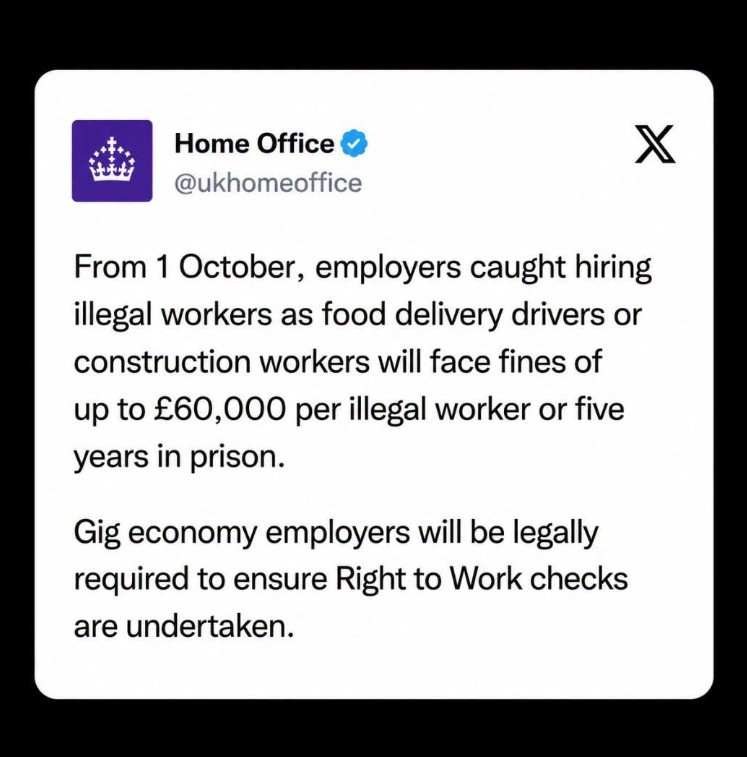
From 1 October 2026, the Right to Work regime is due to extend beyond traditional employees to cover a wider range of working arrangements, including worker contracts, individual sub-contractors and online matching or platform arrangements. For employers in construction, food delivery, courier services, warehousing, beauty, hospitality and other sectors that rely on flexible labour, this is a significant compliance change. OTS Solicitors' Business Immigration Solicitors advise employers and sponsor licence holders on immigration compliance, right to work systems and practical risk management before Home Office action is taken.
The change is not only an immigration issue. It directly affects onboarding, contractor agreements, agency terms, substitution clauses, HR policies, worker status analysis and anti-discrimination practices. In practical terms, employers need to know who is doing the work, who checked their right to work, what evidence has been retained, and whether contractual documents support the compliance position.
The penalties for getting this wrong are serious. Employers may face civil penalties of up to £60,000 per illegal worker, criminal exposure in serious cases, reputational damage, publication by Immigration Enforcement and, for sponsor licence holders, possible sponsor compliance consequences. The safest approach is to audit labour supply arrangements now rather than waiting until the October 2026 deadline.
For business immigration, sponsor licence and employment law advice, call London-based OTS Solicitors on 0203 959 9123 or contact us online.
Why this matters for employers in 2026
Right to work checks have traditionally been associated with direct employment: a new employee joins the business, HR carries out the prescribed check before work starts, records are retained, and a follow-up check is diarised where the worker has time-limited immigration permission. That model is no longer enough for many businesses.
Modern workforces are more complex. A warehouse may use direct employees, agency workers, casual staff, subcontractors and platform labour. A construction company may have layers of subcontracting and substitute workers on site. A food delivery or courier business may operate through app-based or self-employed arrangements. A beauty business may use self-employed individuals, chair renters or casual workers. A hospitality business may use zero-hours staff and agency cover at short notice.
The Government's direction is clear: businesses should not be able to avoid illegal working obligations simply because labour is described as self-employed, casual, platform-based or outside a standard employment contract. That is why the October 2026 changes should be treated as a board-level compliance issue, not simply an HR administration task.
What is changing from 1 October 2026?
The updated Home Office Code of Practice confirms that the new version will come into force on 1 October 2026 and applies to wider working arrangements, including workers under a worker's contract, individual subcontractors and online matching service arrangements. It also addresses arrangements involving substitution clauses and contractual chains.
The practical effect is that businesses will need to look beyond the payroll. If an individual is personally providing work or services through a structure that falls within the extended Right to Work Scheme, the business may need to ensure prescribed checks or prescribed contractual arrangements are in place before the work starts.
There remains an important distinction. Genuinely self-employed individuals who operate in business on their own account, trade in their own name or through their own business, and contract directly with clients or customers to supply services may not be in scope in the same way. However, the line between a genuine business-to-business arrangement and a labour-supply arrangement can be difficult in practice. This is why employers should not rely on labels alone.
Key points for employers
| Issue | What employers need to know |
| Start date | The updated Right to Work Code of Practice comes into force on 1 October 2026. |
| Workers in scope | The wider regime may cover worker contracts, individual subcontractors, platform or online matching arrangements and substitution structures. |
| Sectors affected | Construction, food delivery, courier services, warehousing, beauty, hospitality and other flexible labour models should review their position. |
| Penalty risk | Civil penalties can reach up to £60,000 per illegal worker, with criminal risk in serious cases. |
| Sponsor licence risk | Sponsor licence holders should treat right to work compliance as part of wider Home Office audit readiness. |
| Employment law overlap | Contracts, handbooks, onboarding policies, agency terms and worker-status assessments may all need review. |
| Best practical step | Map every working relationship and audit missing or incomplete checks before October 2026. |
Why sponsor licence holders need to pay particular attention
Sponsor licence holders are already expected to maintain robust HR systems and show that they can comply with Home Office requirements. The extension of Right to Work checks creates another reason to review how sponsored and non-sponsored workers are onboarded, monitored and recorded. Our Sponsor Licence Audit and Compliance Solicitors advise businesses on preparing for Home Office visits, managing key personnel duties and correcting compliance weaknesses before they become enforcement issues.
The risk for sponsors is that a business may have good systems for sponsored employees but weaker controls for contractors, agency workers, casual staff or platform labour. Home Office compliance visits rarely look at one issue in isolation. If an employer cannot explain who is on site, who is providing services, who completed checks and how records are retained, that can raise wider questions about the organisation's compliance culture.
For businesses in construction, logistics, food delivery and warehousing, the supply chain may be as important as the direct workforce. A sponsor should know whether individuals are employees, workers, agency staff, subcontractors, substitutes or platform workers. It should also know which checks are required, who is responsible for them, and what contractual rights the business has to see evidence.
Why this is also an employment law issue
Employers should avoid treating the October 2026 change as a narrow immigration update. It is also an employment law and HR governance issue. OTS Solicitors' Employment Law Solicitors for Employers can assist businesses with employment contracts, contractor terms, staff handbooks, HR policies, onboarding processes, disciplinary procedures and workforce status issues alongside immigration compliance advice.
The reason the two areas overlap is simple: the right to work process depends on knowing the legal and practical relationship between the business and the person performing the work. Is the individual an employee, a worker, an individual subcontractor, a substitute, an agency worker or genuinely self-employed in business on their own account? The answer may affect right to work obligations, employment rights, tax risk, holiday pay, national minimum wage, termination rights and discrimination duties.
Businesses should also be careful not to respond to the new rules in a discriminatory way. Right to work checks should be applied consistently and fairly. Employers should not single out workers because of nationality, ethnicity, accent, appearance or assumptions about immigration status. An over-cautious but inconsistent approach can create discrimination risk at the same time as the business is trying to solve an immigration compliance problem.
This is why updating contracts alone is not enough. Businesses should align immigration compliance, employment documentation and operational practice. The paper process should match what actually happens on site, on shift, on the platform or in the warehouse.
What employers should audit before October 2026
The first step is to map the workforce. Employers should identify every category of person who provides work or services to the business. This should include direct employees, zero-hours staff, agency workers, consultants, self-employed individuals, individual subcontractors, casual workers, platform workers, delivery drivers, warehouse operatives, cleaning staff, beauty workers, construction workers and substitutes.
The second step is to identify which relationships are potentially within the expanded Right to Work Scheme. This is a legal and factual assessment. The contract label is relevant, but it is not the end of the analysis. The business should consider who controls the work, who provides the labour, whether personal service is required, whether substitution is allowed, and whether the individual is genuinely running an independent business.
The third step is to check documents and processes. Employers should ask:
- Are right to work checks being completed before work starts?
- Are follow-up checks diarised for workers with time-limited permission?
- Are share codes and online check records stored properly?
- Are agency and platform agreements clear about right to work responsibilities?
- Does the business have the right to inspect compliance evidence?
- Does the onboarding process apply consistently across all locations and managers?
- Do line managers know who can start work and who cannot?
- Are substitute workers prevented from working until checks are complete?
The fourth step is to update policies and training. A policy that only refers to employees may be too narrow. Onboarding checklists, HR manuals, contractor terms and manager training may all need to be updated. For businesses with multiple sites or fast-moving labour needs, training should be practical and simple enough for managers to follow under pressure.
Agency, subcontractor and platform arrangements
Many employers assume that if an agency, subcontractor or platform is involved, right to work responsibility sits entirely with that third party. That assumption may be unsafe. The new regime is designed to close gaps in flexible working arrangements. Businesses should review contracts carefully and should not assume that a third party's check automatically protects them.
Commercial agreements should deal clearly with responsibility for right to work checks, evidence retention, audit rights, notification duties, substitution, indemnities and the consequences of non-compliance. Where a business relies heavily on outsourced or platform labour, it should be able to explain its control systems if questioned by the Home Office.
This does not mean every contractor arrangement is automatically high risk. Some genuine business-to-business arrangements may be outside the scope of the extended scheme. However, employers should document why a particular arrangement is treated in that way. If the reality is that individuals are being supplied to perform work personally within the business, the risk analysis is very different.
What are the penalties for getting Right to Work checks wrong?
The headline civil penalty remains severe: up to £60,000 per illegal worker. In serious cases, employers may also face criminal investigation where there is knowledge or reasonable cause to believe that a person is working illegally. A business may also suffer reputational damage, publication by Immigration Enforcement and disruption caused by enforcement visits.
For sponsor licence holders, illegal working concerns can also create immigration compliance risk. A Home Office concern about right to work systems may lead to questions about wider sponsor management, record keeping and reporting duties. In the worst cases, sponsor licence action can affect a business's ability to employ sponsored workers and can disrupt recruitment planning.
The purpose of a prescribed right to work check is to establish a statutory excuse against liability for a civil penalty if it later emerges that a person did not have permission to do the work in question. That protection depends on carrying out the correct check at the correct time and keeping the correct evidence.
Practical action plan for employers
Employers should use the period before 1 October 2026 to prepare. A sensible action plan would include:
- conducting a workforce mapping exercise across all sites and labour models;
- auditing right to work records for employees, workers and non-standard labour;
- reviewing agency, subcontractor and platform agreements;
- updating employment contracts, contractor terms and substitution clauses;
- updating staff handbooks and onboarding policies;
- training HR, recruitment teams, site managers and operations managers;
- checking sponsor licence compliance systems and key personnel responsibilities;
- creating a central process for follow-up checks and Employer Checking Service cases;
- ensuring right to work checks are carried out consistently to reduce discrimination risk.
Businesses that wait until October may find themselves trying to fix contracts, policies, evidence gaps and workforce data at the same time. That is rarely the most efficient or least risky way to respond. The earlier the audit takes place, the easier it is to identify and correct gaps.
OTS Solicitors' view
In our view, the October 2026 change is one of the clearest examples of immigration compliance and employment law becoming inseparable. A business cannot manage right to work obligations properly unless it understands how people are engaged, how work is allocated, how substitutions operate, and how agency or platform arrangements are documented.
For sponsors, this should be treated as part of wider Home Office audit readiness. For employers in construction, food delivery, courier work, warehousing, beauty and hospitality, it should be treated as an urgent HR and compliance project. The businesses most exposed are likely to be those with fast onboarding, decentralised site management, multiple labour suppliers and informal arrangements that have grown over time.
Legal advice at this stage can help employers identify which working relationships are in scope, update documentation, reduce discrimination risk and prepare managers for the new regime. The objective is not simply to avoid a fine. It is to build a workforce compliance system that is legally sound, commercially workable and capable of standing up to Home Office scrutiny.
For Right to Work, sponsor licence and employment law advice, call London-based OTS Solicitors on 0203 959 9123 or contact us online.
FAQs for employers about the October 2026 Right to Work changes
Do Right to Work checks apply to self-employed workers from 1 October 2026?
The extended scheme can apply to certain non-standard working arrangements, including individual subcontractors and platform or online matching arrangements. Genuinely self-employed individuals operating in business on their own account may be treated differently, but employers should take advice because the distinction can be fact-sensitive.
Which sectors are most affected?
The Government has specifically referred to sectors such as construction, food delivery, beauty salons, courier services and warehousing. Hospitality, cleaning, logistics and other flexible labour sectors should also review their arrangements.
Can an employer rely on an agency or platform to do the checks?
Not automatically. Employers should review the contractual arrangement and understand whether it creates a statutory excuse or whether further prescribed steps are required. Audit rights and evidence access are likely to be important.
What is the maximum civil penalty for illegal working?
The maximum civil penalty can be up to £60,000 per illegal worker. The actual risk depends on the circumstances, including whether the employer has a statutory excuse and whether there have been previous breaches.
Do sponsor licence holders need to do anything different?
Sponsor licence holders should review right to work systems as part of wider sponsor compliance. The Home Office may look at the employer's overall compliance culture, including HR systems, record keeping, reporting and how the business manages non-standard labour.
What should employers do now?
Employers should map the workforce, audit right to work records, review contracts with agencies and platforms, update handbooks and onboarding processes, train managers and take advice on complex worker-status or subcontracting arrangements.